
The physics of light has been studied for centuries and the concept of light comes down to two things. Light can be considered a “waveform” or a particle (photon). When we talk about gathering light from the sky, it is easiest to think about it as “photons” or packets of light. We’ll get back to the waveform concept in a later description.
We can think of photons like hail falling to the ground. If we had a small bucket collecting the hail, we’d have a small amount of hail collected during a period of time. But if we use a bigger bucket, all the more hail stones that can be collected.
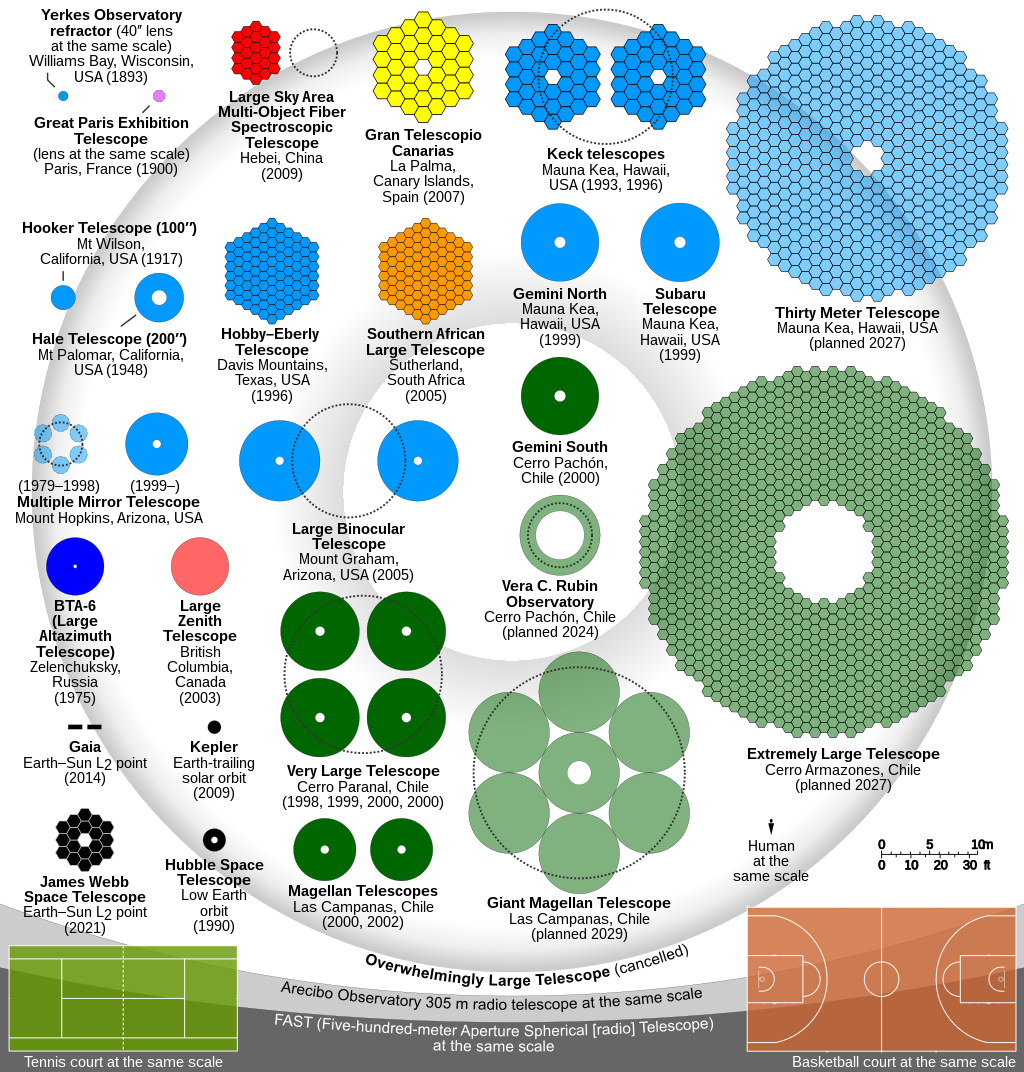
I started my nighttime imaging with a camera lens (bucket) of ~ 70 mm and I have gradually moved up to telescope with a 235 mm diameter. Clearly not in the range of the scientific scopes used to study the skies. To get a perspective of size, the image to the right compares the size of telescopes around the World. There’s a little man in the bottom right of the image and my current scope would be about the size of the little man’s head.
Now if you compared my ability to capture photons from distance images to let’s say the James Webb Telescope, you can certainly see with the bigger telescope you can collect more photons and thus not require as much time to capture the same amount of photon needed for the smaller scope.
There is some compensation that can be used to increase the amount of photons collected in my small bucket. And that compensation is time. I am not taking a single exposure of an image, rather I am collecting those photons over a longer period of time. Some of my images are taken as multiple images collected over 10, 20 30 and even up to 40 hours of time.
That’s how these dim images in the sky can finally be seen.

 SingerAstro